

Oftentimes, we think of an injury as the last rep—the proverbial straw that broke the back. But what if that rep was simply the final piece in a much larger puzzle?
What about the other 23 hours of the day? Is it really the last rep that causes the injury, or is that just the moment when the total load finally exceeds the body’s capacity?
Injuries rarely come from a single moment. More often, they happen when load exceeds capacity—when the forces placed on the body through volume, intensity, or speed outpace what it can currently handle.
Understanding this relationship helps athletes and coaches make smarter decisions and stay comfortably under the line, rather than waiting until the line fights back.
Think of capacity as a line: the amount of stress your body can safely tolerate.
Touching the line doesn’t mean you instantly implode. Pressing five extra pounds, for example, probably won’t cause an injury on its own. The risk increases when you repeatedly push beyond your current capacity without enough training, recovery, or adaptation.
Several factors contribute to your total daily load—like boxes stacking higher and higher beneath your capacity line:
An athlete works a long day, heads to the gym, and starts a familiar workout. Nothing on the whiteboard looks especially intimidating.
But they slept poorly, their nutrition has been less than ideal, and they’re not feeling fully recovered. Their recovery box is already pretty big—but they decide to warm up and see how things go.
Lunges feel fine. Box jumps are going well…until fatigue arrives early. Then, on the final kettlebell swing, their back flares up.
It wasn’t necessarily the kettlebell. It was the stack of boxes that had already brought them close to the line before they even walked into the gym.
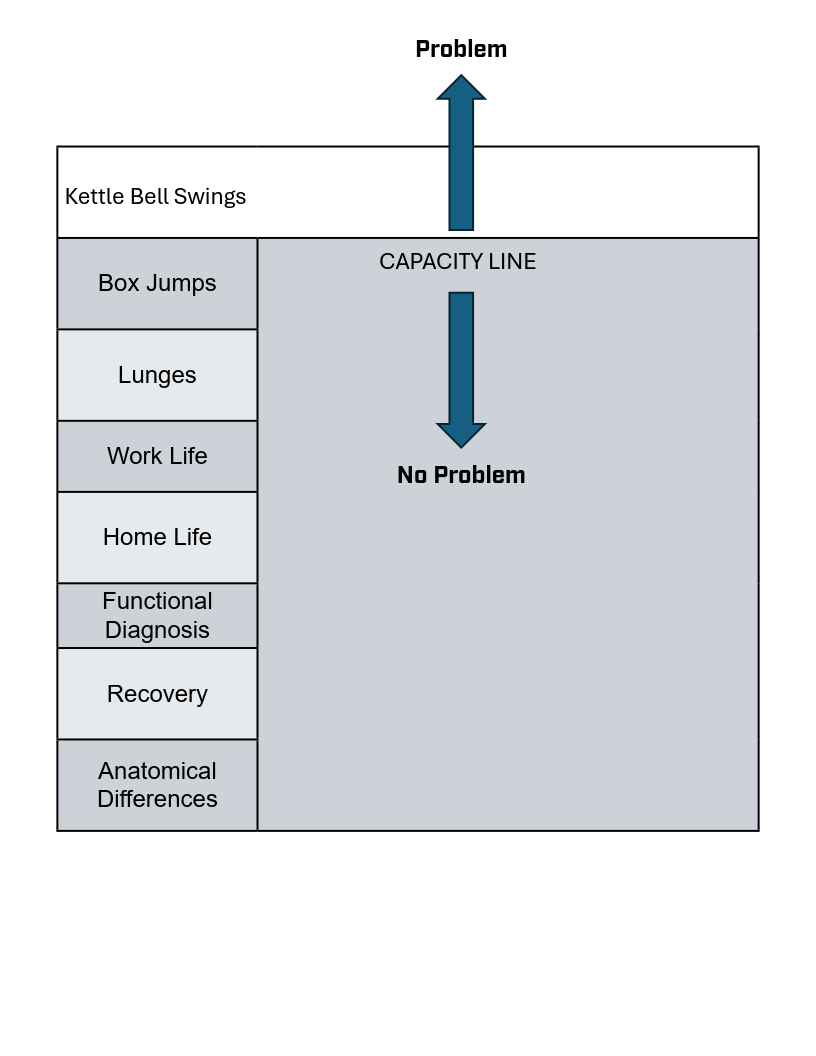
We have more control over some boxes than others.
Recovery is often the biggest opportunity: sleep, nutrition, hydration, rest, and choosing the right intensity for the day can dramatically change how much capacity we have available.
Anatomical differences are largely outside our control. Daily activities—work, family, and responsibilities—fall somewhere in the middle. Some can be adjusted; others simply need to be managed.
Injury prevention is a two-part strategy:
The goal isn’t to avoid every challenge. It’s to understand your current capacity, manage the boxes, and stay active while pursuing bigger goals with less risk of injury.














.png)
.png)
.png)
.png)